


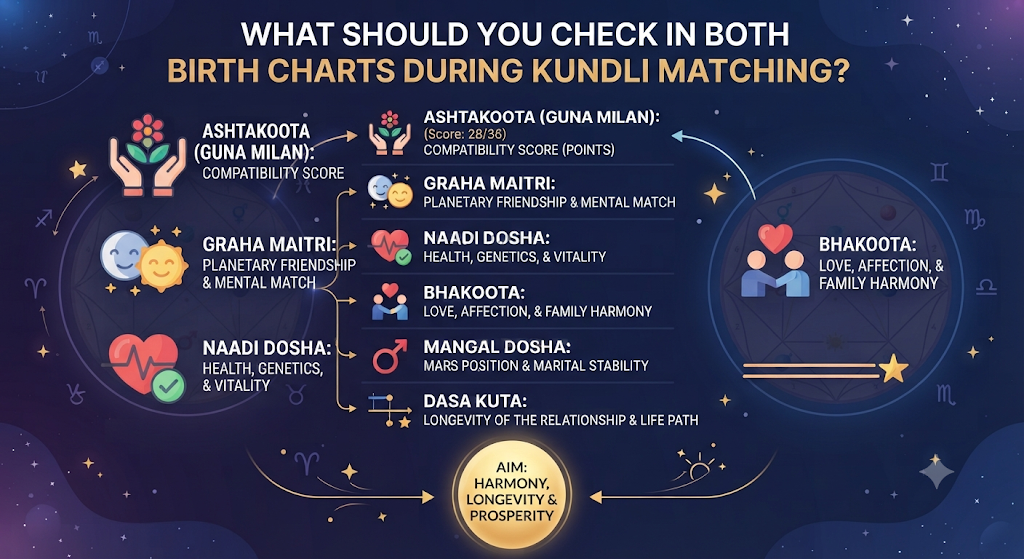
Kundli matching is a traditional part of many Vedic marriage discussions. It involves comparing the birth charts of two individuals to understand different aspects of compatibility. While the Guna Milan score is often the first thing couples notice, a detailed reading may consider several other factors in both charts.
Comparing both charts can provide a broader astrological view of marriage compatibility. Here are the key areas to check.
1. Confirm the Birth Details First
Before interpreting either chart, make sure the date, time, and place of birth are as accurate as possible. These details are used to calculate the Ascendant, houses, planetary placements, and nakshatra.
An incorrect birth time can affect the Lagna and house positions. If the birth time is uncertain, mention this to the astrologer rather than treating an estimated chart as exact.
2. Compare the Moon Signs and Nakshatras
The Moon sign and birth nakshatra are important in the Ashtakoota system of Guna Milan. The Moon is traditionally associated with the mind and emotional responses, while the nakshatra provides another layer of interpretation.
Astrologers compare these placements to calculate the eight Kootas, which together carry a maximum of 36 points. The result is commonly used to discuss traditional compatibility factors such as temperament and emotional understanding.
However, the score should be read alongside the rest of both charts. It is not a complete measure of how a couple will relate to each other.
3. Examine the Lagna and Its Ruling Planet
The Lagna, or Ascendant, is the sign rising on the eastern horizon at the time of birth. It forms the starting point of the birth chart and is traditionally associated with a person’s general outlook and approach to life.
Check the Lagna in both charts, along with the placement and condition of each Lagna lord. Astrologers may compare these factors to consider how partners approach responsibilities, decisions, and everyday situations.
Different Ascendant signs do not automatically indicate incompatibility. The complete chart matters more than comparing signs alone.
4. Study the Seventh House of Marriage
The seventh house is one of the main areas examined in a traditional marriage reading. It represents committed partnerships and is considered for themes related to marriage and cooperation.
In both charts, astrologers may look at:
- The sign occupying the seventh house.
- The planet that rules the seventh house.
- Planets placed in the house.
- Aspects or influences from other planets.
These details are interpreted together; no single placement predicts married life.
5. Check Venus and Jupiter
Venus and Jupiter are commonly considered in Vedic marriage analysis, although their interpretations depend on the chart and astrological tradition.
Venus is traditionally associated with affection, attraction, relationships, and harmony. Jupiter is linked with wisdom, guidance, growth, and marriage-related themes. Astrologers may examine their signs, house placements, strength, and planetary influences in both charts.
Neither planet should be interpreted in isolation; its role depends on the wider chart.
6. Review the Navamsa Chart
The Navamsa chart, also called the D9 chart, is commonly studied alongside the main birth chart in Vedic astrology. It is traditionally used for a deeper interpretation of marriage, partnerships, and planetary strength.
An astrologer may examine the seventh house and its lord in the Navamsa, along with Venus, Jupiter, and other relevant planets. The D9 chart complements rather than replaces the birth chart.
7. Understand Doshas and Their Context
During kundali matching, astrologers may also check for traditional doshas, including Mangal Dosha. This assessment considers Mars in specific houses and may involve examining both charts for relevant conditions or cancellation factors.
A dosha should not be treated as an automatic reason to reject a match. Its interpretation depends on the complete chart. Couples should ask for an explanation rather than rely on a label.
8. Consider Dasha Periods and Current Transits
Dasha periods describe planetary cycles used in Vedic astrology to interpret different phases of life. Astrologers may examine the running and upcoming periods in both charts, particularly when discussing marriage timing.
Planetary transits, or Gochar, may also be considered in relation to marriage-related houses and planets. These techniques add a timing perspective; they do not confirm that a wedding will happen or guarantee a particular outcome.
Look at Both Charts as a Whole
A thoughtful kundali matching reading goes beyond the Guna Milan score. The Moon signs, nakshatras, Lagnas, seventh houses, Venus, Jupiter, Navamsa charts, doshas, and Dasha periods may all contribute to the traditional interpretation.
Couples should also discuss practical expectations around family, finances, careers, communication, and future plans. Astrology is a traditional interpretive practice, not a scientific measure of relationship success. Use it as one perspective while giving equal importance to mutual respect, shared values, and the decisions both partners make together.










Leave a Reply