


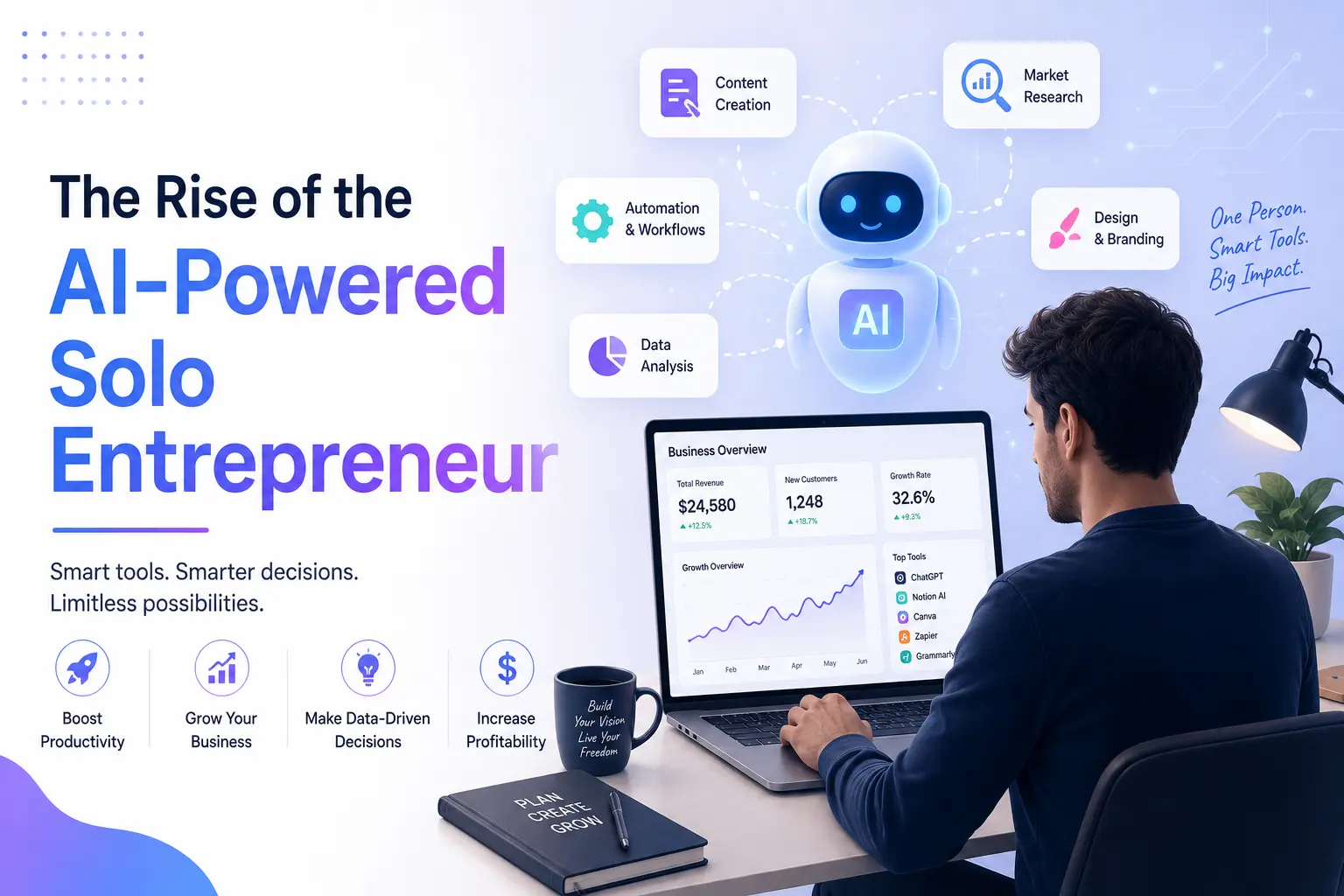
The landscape of business ownership is undergoing a fundamental shift. Where once a startup required a team of specialists to handle everything from coding to customer outreach, modern solo entrepreneurs are now leveraging artificial intelligence to perform these roles independently. This democratization of expertise allows individuals to launch, manage, and scale complex ventures that were previously reserved for organizations with significant payrolls.
Democratizing Business Capabilities
AI acts as a force multiplier for the individual founder. By lowering the barriers to entry—specifically regarding technical knowledge, marketing prowess, and capital requirements—it enables a new wave of “portfolio careers” where owners manage multiple income streams simultaneously. The primary transformation lies in how AI bridges skill gaps, allowing a designer to build a functional app or a writer to run sophisticated ad campaigns without hiring external contractors.
-
Skill Augmentation: AI systems synthesize domain-specific knowledge in real-time, helping founders acquire and apply expertise that historically required years of specialized training.
-
Operational Velocity: Complex workflows, such as data annotation, code debugging, and content brainstorming, can now be executed in minutes rather than days.
-
Cost Efficiency: Automating high-value tasks reduces the need for expensive infrastructure, enabling founders to bootstrap ventures with minimal upfront financial investment.
-
Personalized Outreach: AI tools refine customer communication by analyzing tone and context, ensuring that solo operators can maintain high-quality client relationships at scale.
Strategic Integration for Solopreneurs
Success as an AI-powered solo owner requires more than just access to tools; it demands a disciplined approach to how those tools are integrated into daily operations. Founders must treat AI as a persistent “copilot” rather than a replacement for strategic vision.
-
Define Small, Actionable Tasks: Break large business goals into granular problems that AI can solve with high precision, rather than asking it to build an entire company from scratch.
-
Maintain Human Oversight: Use AI to generate drafts, code, or marketing variations, but always apply your own domain expertise to review, critique, and finalize the output.
-
Leverage Feedback Loops: Actively prompt your AI assistant to challenge your ideas or identify gaps in your business plan, as a solo founder lacks the natural checks and balances of a team.
-
Prioritize High-ROI Workflows: Focus AI deployment on time-consuming areas—such as lead nurturing, content production, or logistical planning—to free up time for high-level strategy.
-
Build Custom Tooling: Rather than relying solely on off-the-shelf software, utilize no-code platforms to build purpose-built solutions that fit your specific workflow.
Navigating the Challenges of Independence
While AI increases the potential for individual success, it also introduces specific risks. Without a team, founders can easily fall into “echo chambers” where poor strategic decisions go unchallenged. Furthermore, the ease of entry means that the market is more competitive than ever. Sustaining a long-term advantage requires founders to pair AI’s speed with deep, authentic human connections and original creativity—assets that remain difficult for models to replicate. Those who succeed are the ones who combine technology-driven efficiency with a strong, distinct brand identity that resonates on a human level.
Conclusion
The rise of the AI-powered solo entrepreneur marks the beginning of a more flexible and accessible era of business. By mastering the synergy between machine speed and human intuition, individuals can build resilient, impactful ventures. As these tools continue to evolve, the distinction between a “solo” venture and a “team-based” firm will continue to blur, making the founder’s ability to act as a strategic orchestrator the most valuable skill in the modern economy.
Frequently Asked Questions
1. Is AI replacing the need for traditional business education?
AI provides instant access to information and expertise, but it does not replace the critical thinking, ethical judgment, and strategic experience required to manage a business successfully.
2. Can a solo entrepreneur really compete with large teams?
Yes, by using AI to automate resource-heavy tasks like marketing, lead generation, and coding, solo owners can achieve similar output levels at a fraction of the cost.
3. What is the biggest danger for solo founders using AI?
The primary risk is a lack of critical review; without team members to challenge ideas, founders may rely on flawed AI outputs without realizing the errors until it is too late.
4. How do I start if I have no technical skills?
Begin by using AI for brainstorming and content creation, then slowly transition to no-code platforms that allow you to build apps and automated workflows using plain language.
5. Is the “solo” model suitable for every industry?
While AI makes it possible to start solo in many fields, high-scale or high-risk sectors—like manufacturing or medicine—often still require the collaborative oversight of a dedicated team.







Leave a Reply