


So, Which One Actually Helps You Sleep Better?
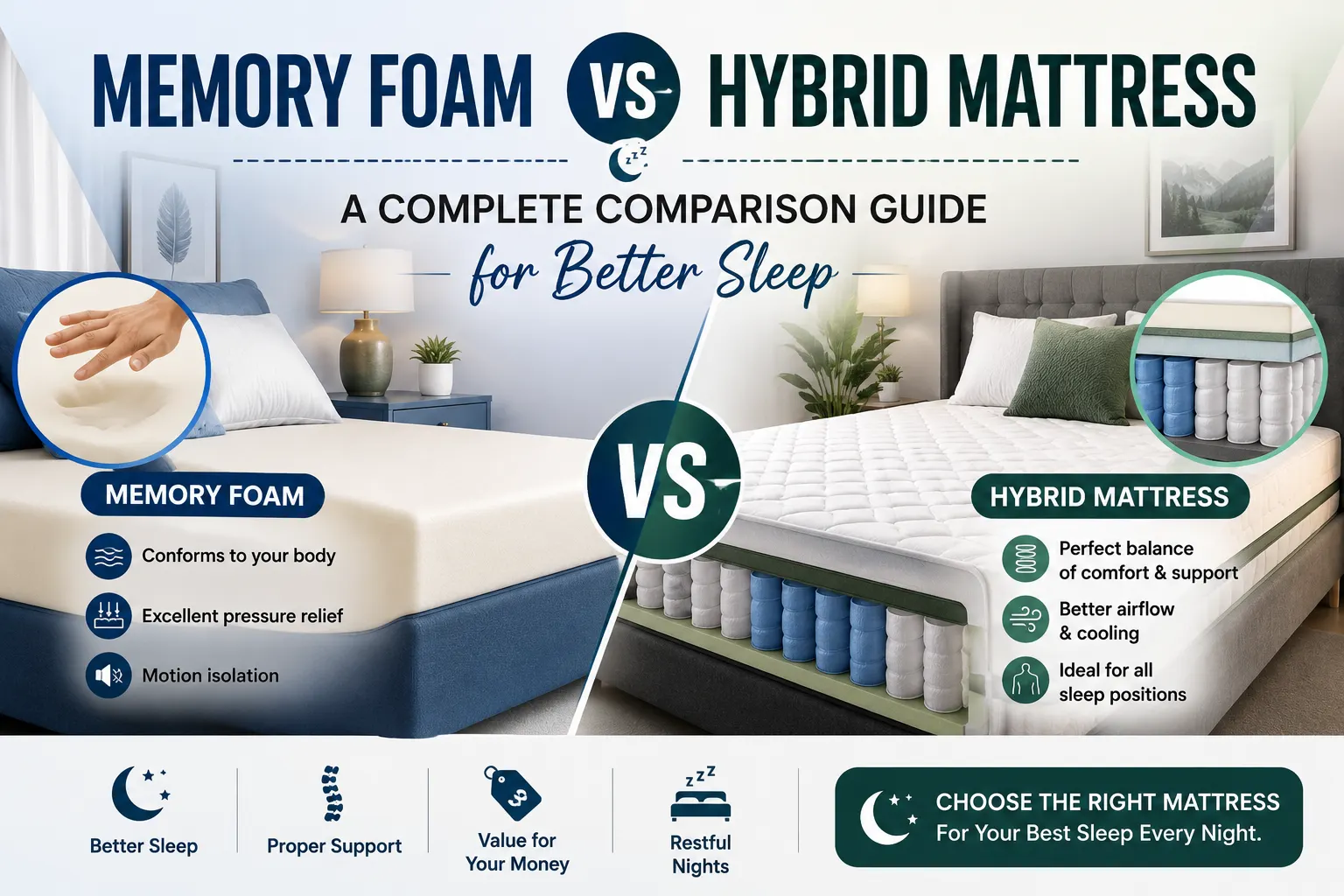
Here’s the honest answer before we go any further: there’s no single “best” mattress between memory foam and hybrid — it depends on how you sleep, how hot you run at night, and honestly, how much you’re willing to spend. If you toss and turn or share a bed with someone who does, a hybrid will probably serve you better. If you sleep mostly on your side and want that “hug me” feeling, memory foam wins hands down.
I’ve slept on both — a plain memory foam mattress for almost four years, then switched to a hybrid after my back started complaining every morning. That switch alone taught me more about mattress construction than any spec sheet ever could. So let’s break this down properly, not as a sales pitch, but as one tired sleeper explaining it to another.
Quick Comparison Table
| Feature | Memory Foam Mattress | Hybrid Mattress |
|---|---|---|
| Construction | Layered foam (memory foam + base foam) | Pocket springs + foam/latex comfort layer |
| Pressure Relief | Excellent, contours to your body | Good, but less “sink-in” feel |
| Motion Isolation | Very good, ideal for couples | Decent, but springs transfer some movement |
| Temperature | Tends to trap heat | Sleeps cooler due to airflow around coils |
| Edge Support | Weak — you feel like you’ll roll off | Strong, good for sitting on the edge |
| Bounce | Minimal, “stuck in place” feeling | More responsive, easier to move around |
| Average Lifespan | 7–10 years | 6–8 years |
| Price Range | ₹15,000 – ₹45,000 (varies by brand/size) | ₹20,000 – ₹60,000+ |
| Best Suited For | Side sleepers, people with joint pain | Combination sleepers, hot sleepers, back support seekers |
Keep in mind, this is a general comparison — individual brands vary a lot in foam density and coil count, so always check the actual specs before buying, not just the category name.
Memory Foam Mattresses: What You’re Really Signing Up For
Memory foam reacts to body heat and pressure. That’s the whole trick behind it — the material softens exactly where your body pushes down and springs back slowly once you move. It’s why people describe it as “sleeping in a hug.”
I liked mine for the first year. Genuinely. My shoulder pain (from years of bad desk posture) eased up noticeably. But by year three, two things bothered me:
- It got warm. Not unbearably, but enough that I’d wake up around 3 a.m. and flip my pillow to the cool side.
- Getting out of bed felt like climbing out of a hole, especially with a stiff back in the morning.
That second point matters more than people admit. If you or your partner get up frequently at night, memory foam’s slow-response nature can be annoying rather than luxurious.
Where Memory Foam Genuinely Excels
- Pressure point relief — great if you have arthritis, shoulder pain, or sleep mostly on your side
- Quiet, no springs — zero creaking, ever
- Motion isolation — your partner can get up at 5 a.m. for the gym and you won’t feel a thing
Hybrid Mattresses: The Middle Ground That Actually Works
A hybrid mattress combines pocketed coil springs at its base with a foam or latex comfort layer on top. Think of it as memory foam’s comfort with an innerspring mattress’s support and airflow.
When my back pain got worse, a physiotherapist actually recommended I try something with “more push-back” — meaning a surface that doesn’t let my spine sink too deep. That’s essentially what a hybrid does. The coils provide structure while the top foam layer still gives some cushioning.
The switch took about two weeks to get used to. It felt firmer initially, almost too firm, but my lower back stopped aching within the first ten days. That’s anecdotal, sure — mattresses affect everyone differently — but it’s not a rare experience either; most orthopedic recommendations lean toward hybrid or medium-firm support surfaces for general back health.
Where Hybrids Genuinely Excel
- Airflow and cooling — the coil layer lets air circulate, so heat doesn’t build up the way it does in solid foam
- Edge support — you can sit on the edge to tie your shoes without feeling like you’ll slide off
- Better for combination sleepers — if you shift positions a lot at night, the responsiveness helps
The Trade-Off Nobody Mentions Enough
Hybrids are usually pricier, and cheaper hybrid models sometimes use thin comfort layers just to hit a lower price point — which means you get spring-mattress feel with a “hybrid” label slapped on. Always check the foam layer thickness (ideally 3+ inches) before assuming a hybrid will feel plush.
Memory Foam vs Hybrid: A Side-by-Side Breakdown by Sleep Style
Side sleepers: Memory foam usually wins here — it cushions the shoulder and hip better, reducing pressure points.
Back sleepers: Either can work, but a medium-firm hybrid tends to keep the spine better aligned.
Stomach sleepers: Hybrid is generally safer — memory foam can let the hips sink too deep, straining the lower back.
Hot sleepers: Hybrid, without much debate. Unless you’re buying a gel-infused or open-cell memory foam specifically designed for cooling, foam traps heat.
Couples with different sleep schedules: Memory foam, for the motion isolation alone.
People with lower back pain: This varies by individual, but many find a medium-firm hybrid more supportive. It’s worth testing both if you can, or checking a mattress brand’s trial period policy before committing.
Price vs Long-Term Value
Memory foam mattresses generally cost less upfront, but if you’re someone who runs warm at night, you might end up buying a cooling mattress topper later anyway — which adds to the total cost. Hybrids cost more initially but tend to need fewer add-ons.
That said, don’t assume “expensive equals better.” I’ve seen budget hybrids with barely 1-inch foam toppers that feel almost like a plain spring mattress, and premium memory foam options that outperform mid-range hybrids on comfort. The category name is a starting point, not the final word — check the layer specs.
A Quick Reality Check Before You Buy
- Trial periods matter more than reviews. Most reputable brands offer 90–100 night trials. Use the full window; a mattress that feels fine on day 3 can feel completely different by week 6.
- Check the warranty terms. Sagging beyond a certain depth (usually 1–1.5 inches) is often what warranties actually cover — not general wear.
- Firmness numbers aren’t standardized. A “medium-firm” from one brand can feel softer than “medium” from another. Testing in-store, if possible, still beats guessing from a chart.
Final Take
If you want deep, cushioned comfort and don’t mind slightly warmer nights, memory foam is still a solid, budget-friendly choice. If you sleep hot, move around at night, or need firmer back support, a hybrid is generally the safer long-term investment. Neither is objectively “better” — it genuinely comes down to your body, your sleep habits, and how much you’re willing to spend for the right fit.
Frequently Asked Questions
1. Which is better for back pain — memory foam or hybrid?
Hybrid mattresses tend to offer more consistent spinal support due to the coil base, though very firm memory foam options can also work well for some people.
2. Do hybrid mattresses sleep cooler than memory foam?
Yes, generally. The coil layer allows more airflow, whereas dense memory foam tends to retain body heat unless it’s gel-infused or has an open-cell structure.
3. Is memory foam or hybrid better for couples?
Memory foam offers better motion isolation, so if one partner moves a lot at night, foam usually disturbs the other person less.
4. How long does a memory foam mattress last compared to a hybrid?
Memory foam mattresses typically last 7–10 years, while hybrids average 6–8 years, mainly because coils wear faster than solid foam under regular use.
5. Are hybrid mattresses worth the extra cost?
For most people who want a balance of comfort and support, yes. But cheaper hybrids with thin comfort layers may not justify the price jump over a good memory foam option.
6. Can a hybrid mattress feel as soft as memory foam?
It depends on the comfort layer thickness. A hybrid with a thick foam or latex top layer (3+ inches) can feel close to memory foam, but the coil base still gives it a firmer base feel.
7. Is memory foam bad for people who sleep hot?
Not always — cooling gel or open-cell memory foam options exist. But traditional dense memory foam does tend to trap heat more than hybrids.
8. Which mattress type is better for stomach sleepers?
Hybrids are usually recommended because they prevent the hips from sinking too deep, which helps avoid lower back strain.
9. Do memory foam mattresses have good edge support?
Not really — this is one of memory foam’s weaker points. Hybrids generally offer noticeably stronger edge support due to the coil structure.
10. How do I know if a hybrid mattress has a good foam layer?
Check the product specs for comfort layer thickness. Anything under 2 inches often won’t feel much different from a regular spring mattress.
11. Is a firmer mattress always better for back support?
Not necessarily. Support depends on proper spinal alignment, not just firmness. A mattress that’s too firm can create pressure points just like one that’s too soft.
12. Do memory foam mattresses smell when new?
Yes, this is common and called off-gassing. It usually fades within a few days to a couple of weeks with proper ventilation.
13. Which is quieter — memory foam or hybrid?
Memory foam is completely silent since it has no moving parts. Hybrids can occasionally develop slight creaking from the coils over years of use.
14. Should I buy based on price or comfort layer quality?
Comfort layer quality matters more long-term. A cheaper mattress with a thin, low-density top layer often wears out or flattens faster, costing more in replacements.
15. Can I try before buying online?
Most trusted mattress brands offer trial periods of 90–100 nights specifically because sleep comfort can’t be judged in a few minutes in a showroom.











Leave a Reply