


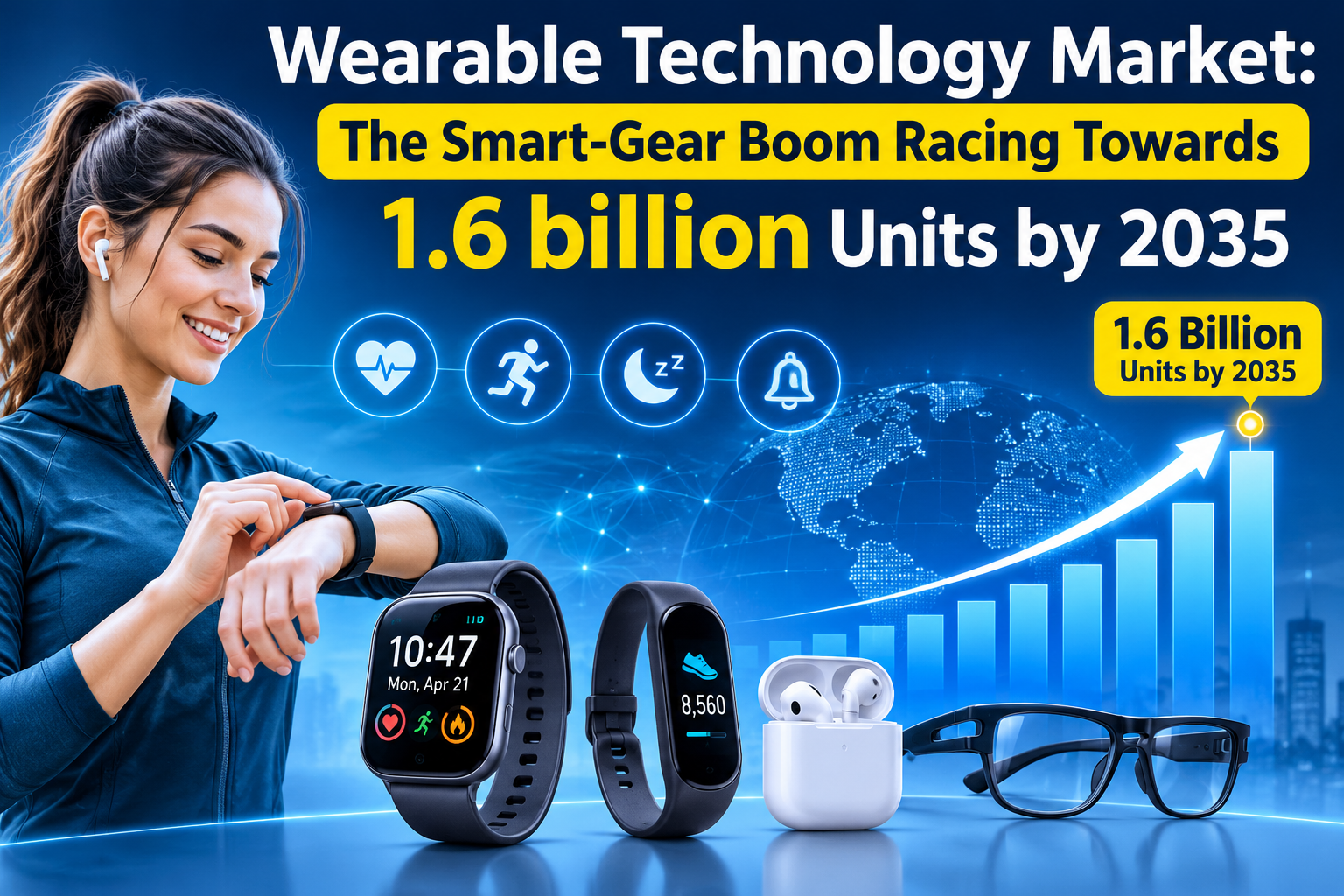
Smartwatches, rings, earbuds and even smart shoes now monitor our activity, sleep and recovery. Consumers wear wearables for function, not just fashion. This means that connected devices are going from gym bags to gym floors. This piece discusses the size, drivers, trends, segments and the players impacting the industry through 2035.
Revenue estimates for the Wearable Technology Market include wearables used for active health monitors, complete health & fitness monitors, remote healthcare and other applications. Wearables provide real-time updates on sleep, stress, and heart rate thanks to advanced software, sensors, and a greater focus on health. In addition, the wearables market is projected to reach 1,630.33 Mn Units by 2035 growing at a CAGR of 17.00% in 2026-2035.
Wearable Technology Market Snapshot
– Volume in 2025: 339.17 million units
– Forecast for 2035: 1,630.33 million units
– CAGR (2026-2035): 17.00%
– Fastest-growing region: Latin America (18.1% CAGR)
– Fastest-growing country: India (18.7% CAGR)
– Fastest-growing product: wrist-wear (19.7% CAGR)
– Fastest-growing component: services (18.3% CAGR)
Factors Contributing to Growth
Increasing Need for Real-Time Health Monitoring
People desire to always have an eye on their health. From smartwatch measuring heart rate, oxygen saturation and sleep to new ones studying glucose monitoring, the use of wearables in healthcare has now advanced to chronic disease monitoring and early detection.
Smartphone Connectivity and Integration
Wearables are also better at connecting with phones for calls, music and notifications. In addition, the mobile network is fast forwarding data transmission with networks such as 5G. Due to this, consumers view these devices as children of mobile devices.
Rising Incomes and Fitness Culture
As consumers in emerging economies enjoy rising disposable incomes, connected devices become affordable. At the same time, the worldwide obsession with good health guides users to fitness bands, recovery straps and coaching software.
Important Trends and Changes
AI-Powered Insights
You no longer need to worry about reading all your sensor data. Turn raw sensor data into advice, personalised for you. WHOOP came to India in September 2024, giving advice on recovery, strain, sleep and stress with its AI coach.
Smart Eyewear and New Form Factors
AR glasses are competing with smartphones. In October 2024, the fifth generation of Snap’s Spectacles has been released, and Meta announced its Orion concept. Sony also released the Reon Pocket 5 wearable air conditioner in April 2024.
Product Launches
– Global launch (October 2024): The Oura Ring 4 from USD 349 with a titanium style and eight days of battery.
– In September 2024, Apple announced the Apple Watch Series 10, which included sleep apnea alert features and faster charging capabilities.
– Huawei released the WATCH GT 5 Series, WATCH D2 and WATCH Ultimate Green in September 2024.
Market Segmentation
By Component
Software converts the raw data into personalised insights and goals. Services pay off via coaching, analytics, and subscriptions. But services are experiencing faster growth at an 18.3% CAGR, as users are willing to pay for personalised programs and extra analytics.
By Product
The categories of wear include wrist-wear, eye-wear and head-wear, foot-wear, neck-wear and body-wear. Smartwatches and bands continue to drive 19.7% CAGR growth because they are lightweight, fashionable and simple to operate on a daily basis. Smart eye and head wear also help users to see and navigate using their hands.
By Technology
These devices are powered by computing, display, networking, positioning and sensor technologies. Improved processors allow faster analysis. And new OLED and micro-LED displays will provide bright, battery-efficient screens.
By Application
The three leading segments of end-use are consumer electronics, healthcare, and enterprise & industrial. Consumers prefer styling and convenience. Healthcare customers prefer active monitoring of vital signs, as that enables them to obtain rapid care.
By Region
North America has the highest market share due to health consciousness and manufacturers like Apple, Fitbit and Garmin. Asia Pacific also rapidly expands as China, Japan and South Korea countries become more electronically inclined. India is estimated to grow by 18.7%, and China is forecast to grow at 17.8%. Latin America is the fastest region growing at 18.1% as middle class grows.
Competitive Landscape
Stand out by leveraging AI, sensors and 5G Brand leaders are:
– Apple Inc.: smartwatches and health features
– Samsung Electronics Co., Ltd.: wearables added to its phone ecosystem
– Garmin Ltd.: sport and fitness devices
– Huawei Technologies Co., Ltd.: health-centered bands and watches
Other respected names on the list are Fitbit, Xiaomi, Alphabet, LG Electronics, adidas, Google, Nike, and Sony.
Key Challenges
– Data privacy concerns around health information
– Battery life limits on small devices
– Intense competition and price pressure
Conclusion
The device market is projected to achieve 17.00% annual growth for wearables for health tracking, AI services and new device form factors. For this reason, companies should focus on developing sensors, software and personalised user experiences to gain advantage. Expert Market Research can help with data, forecasts and strategic analysis.
Frequently Asked Questions
1. What will be the industry volume in 2025?
The industry volume will be 339.17 million in 2025.
2. What is the growth forecast?
Expected to reach 1,630.33 million units by 2035, registering a CAGR of 17.00% from 2026.
3. Which product type is growing at the highest CAGR?
Wrist-wear is the fastest growing product type growing at 19.7% CAGR. Services have the highest growth in components at 18.3% CAGR.
4. Which nations are the strongest grower?
India – 18.7%. China – 17.8%.
5. What are the major players?
Apple, Samsung, Fitbit, Xiaomi, Garmin, Huawei, Google, Nike, Sony.









Leave a Reply