


The Short Answer First
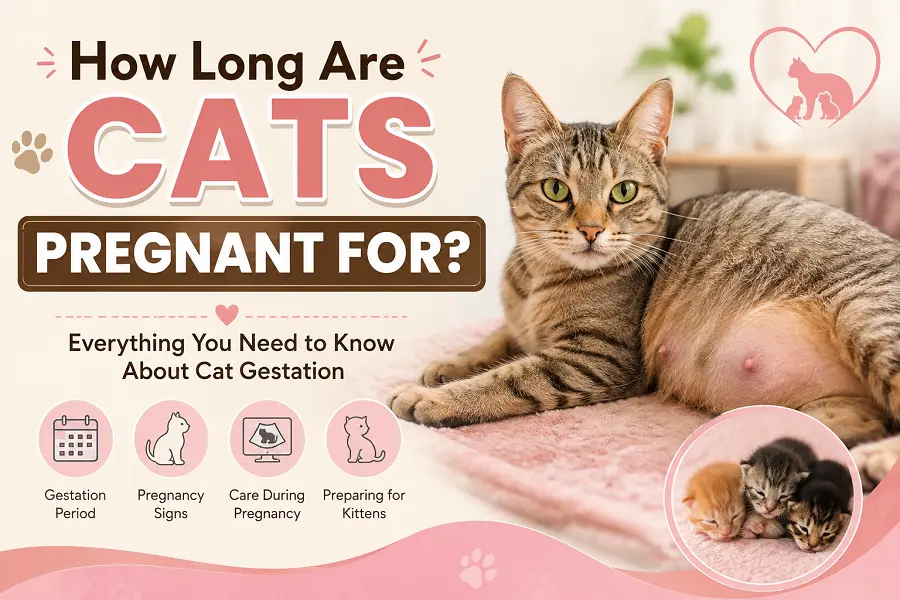
If you’ve got a cat that might be expecting and you’re short on time, here it is: cats are pregnant for about 63 to 65 days, give or take a few days on either side. That’s roughly nine weeks — much shorter than a human pregnancy, and honestly, shorter than most people expect the first time they go through it.
I remember the first time a stray I was feeding turned up looking suspiciously round. I had no idea what I was dealing with, and every “how long is a cat pregnant” search I did gave me a slightly different number — 58 days, 67 days, 9 weeks, 2 months. It was frustrating. So let’s clear that up properly here, with the real range and what actually happens during those two months.
So, How Long Are Cats Pregnant For, Exactly?
The average cat gestation period runs 63 to 65 days from the day she conceives. Some vets will tell you the safe range is anywhere from 58 to 70 days, and both ends of that are considered normal — it’s not necessarily a red flag if your cat delivers a few days earlier or later than the “textbook” number.
A few things nudge that number around:
- Breed — Some purebred cats, like Persians, tend to carry slightly longer than the average moggy.
- Litter size — Bigger litters sometimes arrive a touch earlier than smaller ones.
- First-time mothers — A queen’s (that’s the technical term for a female cat) first pregnancy can occasionally run a few days off from her later ones.
If you know the exact mating date, you can count forward from there. If you don’t — which is common with rescue cats or outdoor cats — you’ll be relying on physical signs and, ideally, a vet visit to estimate how far along she is.
How Cat Pregnancy Compares to Other Timelines
It helps to see this next to something familiar. Dogs are pregnant for about 63 days too, so cats and dogs are almost neck and neck. Humans, by comparison, carry for around 280 days — more than four times as long. Rabbits are on the fast end at around 31 days.
Why does a cat’s body move so much quicker than ours? Cats are what biologists call “precocial-ish” breeders in the sense that kittens are born fairly underdeveloped compared to, say, a foal or a calf — they’re blind, can’t walk properly, and depend entirely on the mother for weeks. Nature trades a shorter pregnancy for a longer, more intensive infancy. It’s a fair trade, evolutionarily speaking, but it does mean new kitten owners have their hands full early on.
Signs Your Cat Might Be Pregnant
Before you can count down the weeks, you need to know she’s actually pregnant. Cats don’t exactly announce it. Here’s what tends to show up, roughly in order:
- Pinking up — Around 2–3 weeks in, her nipples become noticeably pink and slightly enlarged. Vets and breeders call this “pinking up,” and it’s often the first reliable clue.
- Appetite increase — She’ll start eating more than usual, sometimes dramatically so by the second half of the pregnancy.
- Weight gain and a rounder belly — Usually visible from around week 5 onward, though it can vary depending on litter size.
- Nesting behavior — Toward the final couple of weeks, she may start seeking out quiet, enclosed spaces — the back of a closet, under a bed, inside a laundry basket.
- Behavioral shifts — Some cats get noticeably more affectionate; others get more withdrawn or irritable. There’s no single pattern here, honestly, and every cat I’ve known has handled it differently.
A vet can confirm pregnancy through abdominal palpation as early as day 17–25, or with an ultrasound around day 21 onward, which also gives a rough idea of litter size. If money and access allow, an ultrasound is worth it — palpation alone can miss things or be uncomfortable for the cat if done incorrectly by an inexperienced hand.
A Rough Week-by-Week Breakdown
Cat pregnancy doesn’t have the same tidy “trimester” language humans use, but here’s roughly what happens:
Weeks 1–2: Fertilization and implantation. No visible signs yet. This is why so many owners don’t realize their cat is pregnant until she’s already a few weeks in.
Weeks 3–4: Pinking up begins. Morning-sickness-like symptoms (mild vomiting, reduced appetite for a day or two) sometimes appear, though not in every cat.
Weeks 5–6: The belly starts to visibly round out. Appetite increases. This is usually when owners without a known mating date first suspect something’s going on.
Weeks 7–8: Kittens are moving and can sometimes be felt (gently, and ideally by a vet) or even seen shifting under the skin. Nesting behavior kicks in.
Week 9 (days 63–65): Labor typically begins. Some cats go into labor as early as day 58; others wait until day 67 or 68 without it being abnormal.
What Counts as “Too Long” or “Too Early”?
This is where I’d urge some caution instead of just reassurance. If your cat hits day 70 with no sign of labor, that’s worth a call to the vet — it could still be fine, but it’s outside the normal window and deserves a check. On the other end, if she goes into labor before day 58, the kittens may be premature and will likely need extra help surviving, sometimes including supplemental feeding or a warmer environment than the mother alone provides.
Neither of these situations is automatically an emergency, but they’re not something to just wait out either. I’d rather owners call their vet and be told “it’s fine” than not call and have it turn out otherwise.
Practical Tips If Your Cat Is Pregnant Right Now
- Switch her to kitten food around week 5 or 6 — it’s calorie-dense and supports the nutritional demands of pregnancy and nursing better than standard adult food.
- Set up a quiet birthing space a couple of weeks before her due date — a box lined with towels, tucked somewhere low-traffic, works well. She may not use the one you pick, cats being cats, but offer it anyway.
- Skip unnecessary vet stress late in pregnancy unless there’s a real concern — routine handling is fine, but avoid anything invasive close to her due date.
- Don’t bathe her in the final weeks; it can stress her out more than it’s worth.
- Keep other pets separated from the nesting area once she’s close to delivery, especially if you have a dog or an unfamiliar cat in the house.
A Quick Word on Spaying
If this pregnancy was unplanned — which, honestly, is how most cat pregnancies happen — it’s worth talking to your vet about spaying once the kittens are weaned. Cats can get pregnant again almost immediately after giving birth, even while still nursing, which catches a lot of owners off guard. I’ve seen it happen with a friend’s cat who ended up pregnant twice in one year because nobody realized how quickly her cycle came back.
FAQs
1. How long are cats pregnant for on average?
About 63 to 65 days, or roughly nine weeks, from conception to birth.
2. How long is a cat pregnant compared to a dog?
Almost the same — dogs are also pregnant for around 63 days on average.
3. Pregnant cat how long before she shows signs?
Most visible signs, like a rounder belly, don’t show until around week 5. Pinking up (nipple changes) can show as early as week 2–3.
4. Cat how long pregnant before I should take her to the vet?
Ideally as soon as you suspect pregnancy, so the vet can confirm it and check her general health — usually effective from day 17 onward.
5. How long do cats stay pregnant if it’s their first litter?
Roughly the same range, 63–65 days, though first pregnancies can occasionally run a few days shorter or longer.
6. How long cats are pregnant if they’re carrying a large litter?
Larger litters sometimes arrive slightly earlier than average, though this isn’t a hard rule.
7. Can a cat’s pregnancy go past 70 days safely? It’s uncommon and worth a vet check if it happens — prolonged pregnancy can sometimes signal a problem.
8. What’s the earliest a cat can safely give birth?
Around day 58. Kittens born before that are considered premature and need closer monitoring.
9. How can I tell how far along my cat is without knowing the mating date?
A vet can estimate this through physical exam, palpation, or ultrasound, especially between weeks 3 and 6.
10. Do cats show pregnancy symptoms like vomiting?
Some do experience mild, short-lived nausea early on, though it’s less common and less severe than in humans.
11. How many kittens do cats usually have?
Litters typically range from 1 to 6 kittens, with 4 being fairly average, though this varies by breed and the mother’s age.
12. Should I change my cat’s diet during pregnancy?
Yes — switching to a kitten or “growth” formula around week 5–6 helps meet her increased calorie and nutrient needs.
13. Can a pregnant cat still be around other pets?
Generally yes during pregnancy, but it’s best to separate her from other animals once she’s nesting and close to labor.
14. How soon can a cat get pregnant again after giving birth?
Very soon — cats can conceive again even while still nursing a litter, so early spaying discussions with your vet are worth having.
15. Is it normal for a pregnant cat to hide?
Yes, nesting and seeking quiet, enclosed spaces is normal behavior in the final couple of weeks before birth.












Leave a Reply