


The first sign is rarely dramatic. Your father starts holding the railing a little tighter. Your mother takes a short pause on the landing and says she’s “just catching her breath.” Then one day someone suggests moving their bedroom downstairs, and everyone goes quiet, because that room upstairs has been theirs for thirty years.
This is where a lot of families first hear the word stairlift. If that’s where you are right now, this guide covers what a stairlift is, how it works, what it costs in India, and what to check before you buy one.
What is a stairlift?
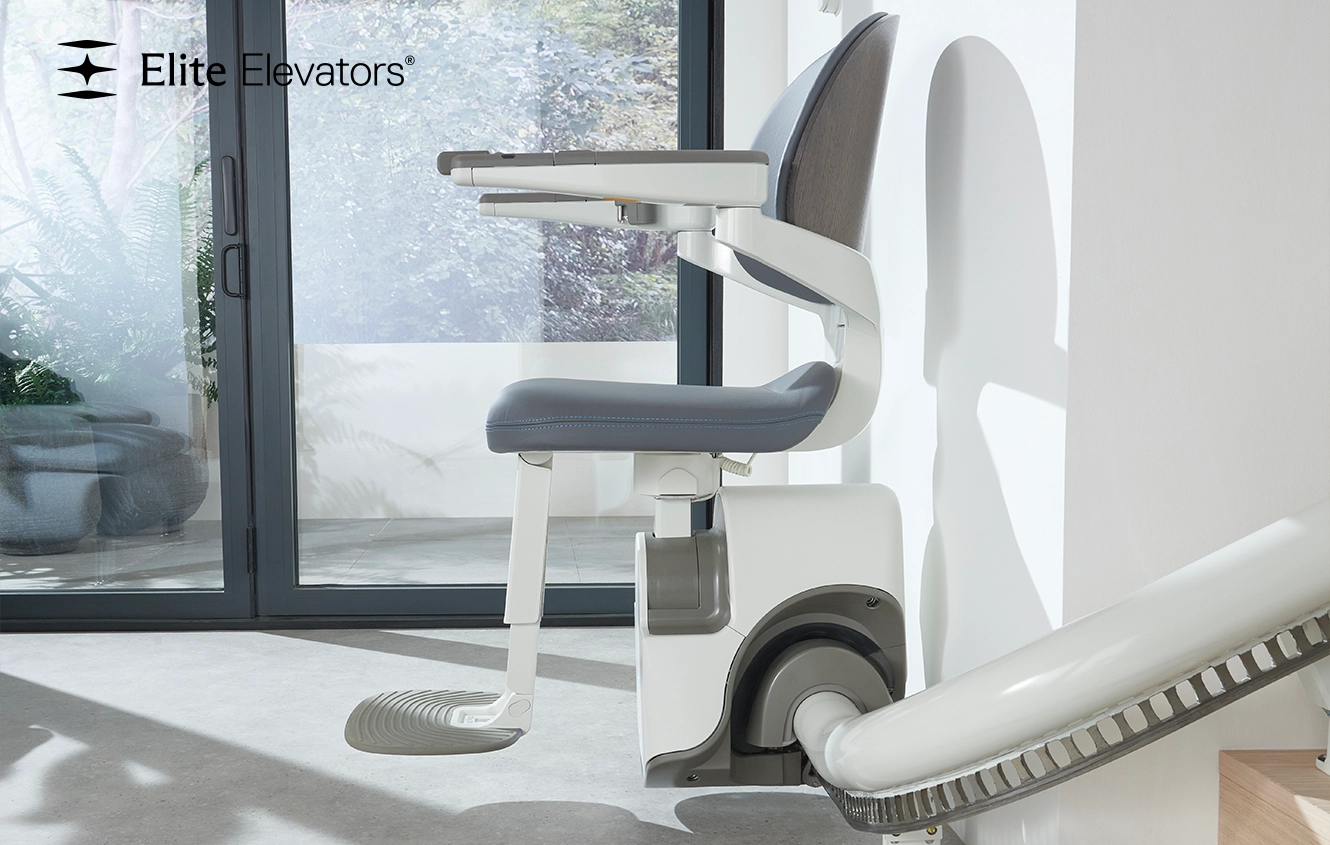
A stairlift is a motorised chair that runs along a rail fixed to your staircase. The person sits down, fastens a seatbelt, presses a button or a small joystick, and the chair glides slowly up or down. At the top, the seat swivels so they can step off safely onto the landing instead of twisting towards the stairs.
The rail is fixed to the steps, not the wall, so in most homes you don’t need any construction. No breaking floors, no shaft, no pit. A straight stairlift can often be installed in a single day.
How does it work?
Most modern stairlifts in homes run on rechargeable batteries. The batteries charge whenever the chair is parked at the top or bottom of the stairs. That’s a big advantage in India, because a power cut doesn’t leave anyone stranded halfway. A fully charged stairlift can usually manage several trips without mains power.
Inside, a small motor drives a gear along a toothed track on the rail. The ride is slow, usually about the pace of a calm walk, and it’s meant to be. Speed isn’t the goal here. Steadiness is.
Types of stairlifts
Straight stairlifts are for staircases that go in one straight line from bottom to top, with no turns or landings in between. The rails are made in standard lengths and cut to size, which keeps the price down and makes installation quick.
Curved stairlifts are for staircases with a turn, a landing in the middle, or a spiral section. And let’s be realistic: a large number of Indian homes, especially duplexes and villas, have exactly this kind of staircase, often an L-shape or a U-shape with a landing. A curved rail has to be custom-made for your stairs, which means a detailed measurement, longer waiting time and a higher price.
Outdoor stairlifts are built to handle rain, heat and dust, for homes where the main steps are outside, such as steps leading up to a first-floor entrance or a terrace.
Standing or perch stairlifts are for people who find it hard to bend their knees and sit down, perhaps after knee surgery or because of arthritis.
What does a stairlift cost in India?
Prices in India vary a lot depending on the brand, whether the unit is imported, and above all the shape of your staircase. As a rough guide for 2026:
- Straight stairlifts: around ₹1.5 lakh to ₹5 lakh
- Curved stairlifts: around ₹8 lakh to ₹15 lakh, sometimes more for complex staircases
You’ll see some very low prices on online marketplaces. Be careful with those. Ask who installs it, who services it, and whether spare parts are available locally. A stairlift that breaks down and waits three weeks for a part from abroad isn’t much help to an elderly parent.
Also ask about:
- Installation charges
- GST
- Warranty on the motor and batteries
- Battery replacement cost (batteries generally need replacing every few years)
- Annual maintenance charges
Safety features to look for
A stairlift carries someone you love up and down a staircase every day, so safety is the most important feature. A good model should have:
- A seatbelt, ideally retractable and easy to fasten with weak hands
- Obstruction sensors that stop the chair if a shoe, a toy or a pet is in the way
- A swivel seat that locks at the top so the user steps off facing the landing, not the stairs
- A key switch so children can’t play with it
- Soft start and soft stop, so there’s no jerk when it moves
- Remote call controls at the top and bottom of the stairs, so the chair can be sent to whoever needs it
- Battery backup, which matters a great deal given power cuts in many cities
Who is a stairlift right for?
A stairlift works well for someone who:
- Can sit down and stand up on their own, or with a little help
- Can transfer safely from the chair to the landing
- Has steady balance once they’re seated
- Lives in a home with a staircase of a suitable width (most need at least about 70–75 cm)
It’s less suitable for someone who uses a wheelchair full-time, because they’ll need a second wheelchair upstairs and help transferring at each end. It may also not be ideal if the person has severe cognitive decline and might unbuckle the seatbelt mid-ride.
Things families often forget to ask
Will the staircase still be usable for everyone else? The rail takes up some space on the stairs, and the chair usually folds up when not in use. In narrow staircases, this can make it a bit tighter for others. Ask for a demonstration of the folded width.
Where will the chair park? If the chair parks at the bottom of the stairs, it may block a doorway or a passage. Some curved models can park around a corner so they’re out of the way.
What happens if the user needs more help later? Health conditions change. Today your mother walks with a stick. In five years she may need a wheelchair. A stairlift can’t adapt to that. A home elevator can. It’s worth thinking a few years ahead.
A small story
A family I know in Pune installed a straight stairlift for their grandfather after his hip surgery. He was suspicious of it for about a week. He called it “the train” and refused to sit on it unless someone stood next to him. Then one evening his grandson found him riding it up just to fetch his reading glasses, quite pleased with himself. The point isn’t the machine. It’s that he could move around his own home again without asking anyone for help.
Final thoughts
A stairlift for home is one of the simplest ways to make a multi-floor home safer for an older family member. It needs little or no construction, installs quickly, and in the case of straight staircases it’s often the most affordable mobility option available.
Measure your staircase, be clear about the user’s current and likely future needs, and ask for an all-inclusive quote with installation, warranty and maintenance spelled out. A little homework now means your family member keeps their room, their routine and their independence.











Leave a Reply