


Starting a business in India requires choosing a legal structure that balances operational flexibility with financial protection. A Limited Liability Partnership (LLP) has become a preferred choice for entrepreneurs, consultants, and small-to-medium enterprises because it blends the operational ease of a traditional partnership with the separate legal identity and limited liability protection of a corporate entity. Governed by the Limited Liability Partnership Act, 2008, an LLP protects its partners. Partners are not personally liable for business debts. They are also shielded from another partner’s misconduct.
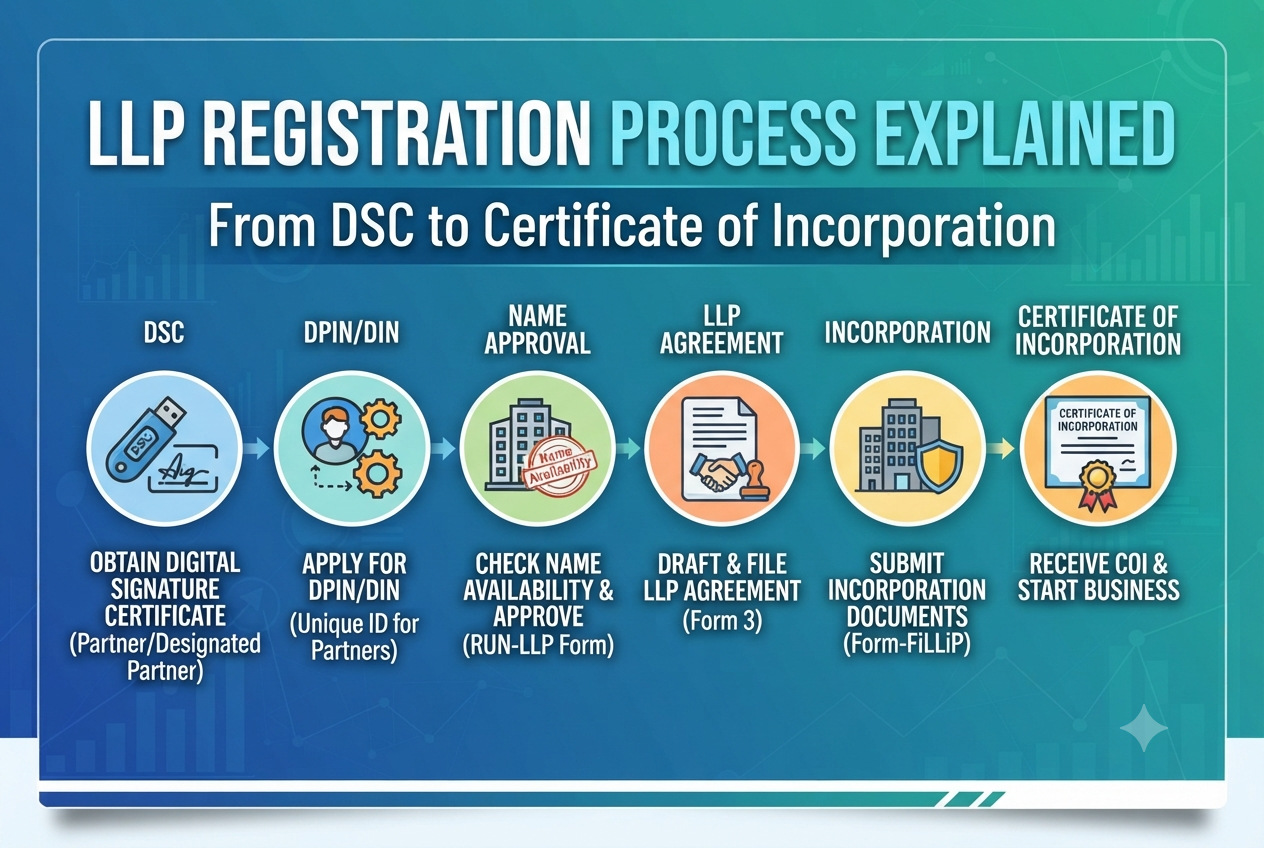
Understanding the llp registration workflow through the Ministry of Corporate Affairs (MCA) V3 portal helps founders navigate regulatory requirements without delays. The end-to-end procedure begins with securing digital credentials for the designated partners. Next, you obtain the official Certificate of Incorporation. Finally, the process concludes with filing the internal partnership deed.
Prerequisite Eligibility and Document Checklist
Before initiating the online application, applicants must ensure the proposed entity meets statutory baseline conditions under the LLP Act:
- Minimum Partners: At least two partners are required to form an LLP, with no upper limit on the total number of partners. Both individuals and bodies corporate (such as companies or other LLPs) can act as partners.
- Designated Partners: Every LLP must appoint at least two individual designated partners responsible for regulatory compliance. At least one designated partner must be a resident of India, having stayed in the country for 120 days or more during the financial year.
- Partner KYC Documents: Scanned copies of each partner’s PAN card (or passport for foreign nationals), identity proof (Aadhaar, Voter ID, or Driving Licence), recent address proof (bank statement or utility bill not older than two months), and passport-sized photographs.
- Registered Office Proof: A recent utility bill or property tax receipt for the business premises, a No-Objection Certificate (NOC) from the property owner, a rental agreement if leased, and the exact latitude and longitude coordinates required on the MCA V3 form.
Step 1: Obtain Digital Signature Certificates (DSC)
The entire incorporation process on the MCA portal is paperless. Therefore, every designated partner must first obtain a Class 3 Digital Signature Certificate. You can get this from a government-recognized certifying authority such as eMudhra, Sify, or NSDL.
Applicants complete video verification and e-KYC using their Aadhaar and PAN details. Ensuring that the name on the DSC matches the applicant’s PAN record prevents technical validation mismatches during form uploads. Once issued, the designated partners must also register or upgrade their user profiles on the MCA V3 portal.
Step 2: Reserve the LLP Name via RUN-LLP
Selecting a compliant and distinctive business name is critical to avoiding registrar objections. Applicants check name availability on the MCA portal. Next, they submit the RUN-LLP (Reserve Unique Name for Limited Liability Partnership) web service. This service lets them propose up to two names per application. They also include the proposed business activity.
- Naming Rules: The proposed name must end with “LLP” or “Limited Liability Partnership” and cannot be identical or deceptively similar to an existing company, LLP, or registered trademark.
- Validity Period: Upon paying the prescribed ₹200 government fee and receiving Central Registration Centre approval, the reserved name remains valid for 90 days, during which the main incorporation form must be submitted.
Step 3: File the Integrated Incorporation Form (FiLLiP)
The FiLLiP (Form for Incorporation of Limited Liability Partnership) serves as the core single-window incorporation application. Founders can either file FiLLiP using a pre-approved RUN-LLP name or apply for name reservation directly within FiLLiP itself. The form consolidates multiple regulatory approvals into a single workflow:
- DPIN Allotment: Designated partners who do not already hold a Director Identification Number (DIN) or Designated Partner Identification Number (DPIN) can apply for allotment for up to five individuals directly within FiLLiP.
- Entity & Capital Details: Applicants enter the registered office address, National Industrial Classification (NIC) business activity codes, total capital contribution, and individual partner shares.
- Attachments & Signatures: All KYC records, office proofs, and signed subscriber sheets/consents (Form 9) are attached, digitally signed via DSC, and certified by a practicing Chartered Accountant, Company Secretary, Cost Accountant, or Advocate. Government filing fees scale according to total partner contribution, starting at ₹500 for contributions up to ₹1 lakh.
Step 4: Verification and Certificate of Incorporation
After submission, the Registrar of Companies (ROC) scrutinizes the FiLLiP application and supporting documents. If any discrepancy or missing document is identified, the ROC raises a resubmission remark, giving applicants a window to rectify the defect without paying fresh fees.
Once satisfied with the filing, the ROC approves the application and issues the Certificate of Incorporation in Form 16. This certificate bears the unique LLP Identification Number (LLPIN) and serves as conclusive legal proof of the entity’s existence. Under the integrated MCA V3 workflow, the LLP’s Permanent Account Number (PAN) and Tax Deduction and Collection Account Number (TAN) are also processed alongside incorporation.
Step 5: Draft and File the LLP Agreement (Form 3)
Receiving the Certificate of Incorporation does not complete statutory onboarding. Within 30 days of incorporation, the partners must execute a formal written LLP Agreement and file it with the MCA using Form 3. This contract defines capital contributions, profit-and-loss sharing ratios, management authority, partner admission or exit rules, and dispute resolution mechanisms. The agreement must be printed on non-judicial stamp paper or e-stamped. This must follow the applicable stamp duty laws of the state where the registered office is situated. Finally, the agreement must be notarized and signed by all partners. Missing the 30-day deadline attracts daily additional late fees.
Once Form 3 is filed and approved, founders can open a dedicated current bank account. They can then deposit capital contributions and apply for GST registration if required. Founders must also stay compliant with annual filings, such as Form 11 and Form 8. Following each stage accurately ensures a smooth, compliant llp company registration experience from initial digital signatures to full operational readiness.










Leave a Reply