


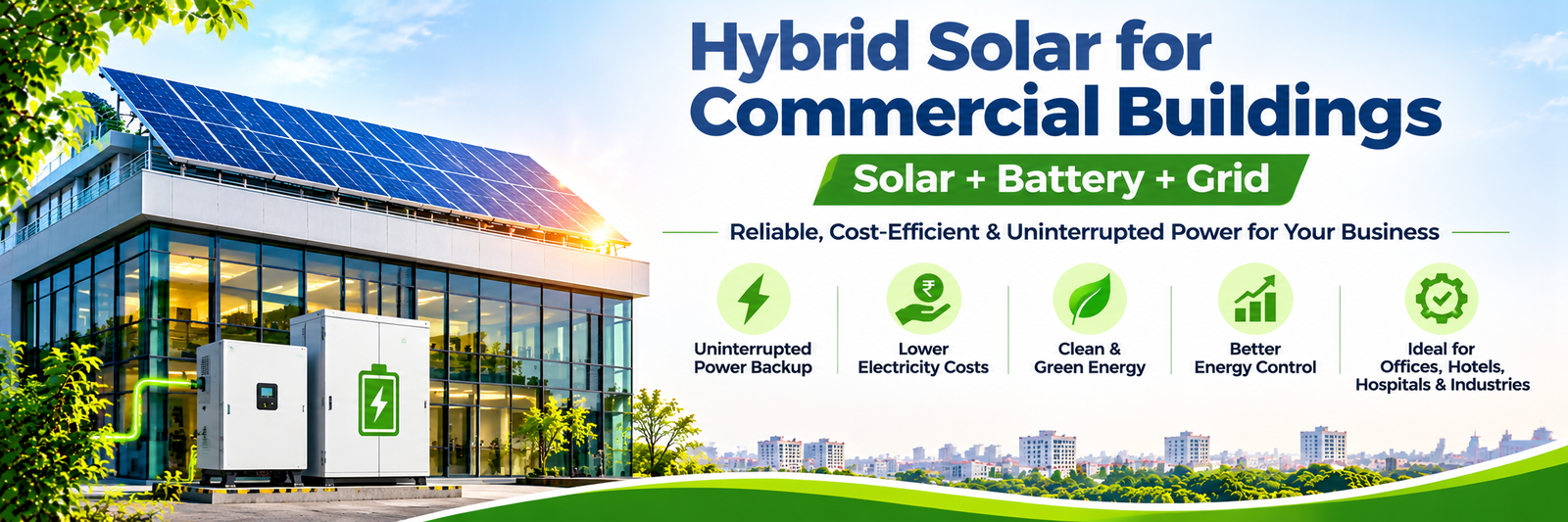
Commercial buildings in Chennai depend heavily on reliable electricity for daily operations. Offices, hotels, hospitals, factories, warehouses, retail facilities and other commercial establishments often operate equipment throughout the day, resulting in significant energy consumption. For businesses looking to control electricity expenses while maintaining reliable power, hybrid solar for commercial buildings in Chennai offers a practical solution by combining solar generation, battery storage and grid power.
Unlike a conventional solar system that primarily generates electricity when sunlight is available, a hybrid solar system can store surplus energy in batteries for later use. This provides businesses with greater flexibility in managing their energy consumption and backup requirements.
What Is Hybrid Solar for Commercial Buildings?
A commercial hybrid solar system combines three major power sources or components:
- Solar power generated through rooftop or ground-mounted solar panels
- Battery energy storage for storing available surplus electricity
- Grid electricity as an additional power source when required
The system uses intelligent power management to determine how electricity is supplied to the building.
During sunny periods, solar energy can be used to power business operations. Excess generation can be stored in batteries, depending on the system configuration. When solar generation is unavailable or insufficient, stored battery energy can be used before drawing additional power from the grid, subject to the system’s operating settings.
This combination makes hybrid solar particularly useful for businesses that require both energy cost management and power continuity.
Why Is Hybrid Solar Becoming Important for Chennai Businesses?
Electricity demand can vary significantly throughout the day. Commercial facilities may also have critical loads that require continuous power.
A hybrid system can help businesses manage these requirements more effectively by combining renewable generation with energy storage.
Key advantages include:
1. Reduce Dependence on Grid Electricity
Solar panels generate electricity during daylight hours, allowing businesses to consume renewable energy directly instead of purchasing the equivalent amount entirely from the grid.
2. Store Excess Solar Energy
Instead of allowing surplus solar generation to go unused, a battery energy storage system can store available energy for later use, depending on system capacity and operating conditions.
3. Improve Power Backup
Battery storage can provide backup power to selected loads during grid interruptions. This can be valuable for businesses where even a short power interruption can affect operations.
4. Better Energy Management
A hybrid system gives businesses greater control over when solar energy, battery power or grid electricity is used.
5. Support Sustainability Goals
Solar energy is a renewable energy source. Businesses adopting hybrid solar systems can support their sustainability and energy-efficiency objectives while reducing dependence on conventional power.
How Does a Commercial Hybrid Solar System Work?
The working principle is straightforward.
Solar Panels → Inverter → Business Loads
When solar generation exceeds immediate consumption:
Excess Solar → Battery Storage
When solar generation is insufficient:
Battery Storage → Business Loads
If additional electricity is required:
Grid → Business Loads
The exact operating sequence depends on the system design, battery capacity, inverter technology and energy-management settings.
Solar + Battery Storage for Hotels and Commercial Facilities
Hotels, hospitals, offices and commercial facilities often have a combination of critical and non-critical electrical loads.
Critical systems may include:
- Security systems
- IT infrastructure
- Network equipment
- Emergency lighting
- Communication systems
- Essential operational equipment
A properly designed battery energy storage system can help support selected critical loads during power interruptions.
For hotels, hybrid solar can also support daytime energy requirements from lighting, air conditioning, kitchen equipment, pumps and other electrical systems, subject to the property’s load profile and system capacity.
Hybrid Solar for Industrial Buildings
Industrial facilities frequently have higher electricity consumption and more complex power requirements.
Manufacturing equipment, motors, compressors, pumps, automation systems and other machinery can create significant energy demand.
A commercial or industrial hybrid solar solution can be designed around the facility’s load profile. Solar generation can support daytime consumption while battery storage can provide additional flexibility for selected loads and energy-management strategies.
Before installation, businesses should conduct a detailed assessment of their electrical demand rather than selecting a battery or solar capacity based only on building size.
How to Choose the Right Hybrid Solar System
The correct system depends on the business’s specific requirements.
Important factors include:
- Monthly electricity consumption
- Peak demand
- Daytime load profile
- Critical load requirements
- Available rooftop area
- Solar potential
- Required battery backup duration
- Battery technology
- Inverter capacity
- Existing electrical infrastructure
- Future energy requirements
A professional energy assessment can help determine the appropriate combination of solar generation and battery storage.
Commercial Hybrid Solar Installation Process
A professional installation typically begins with a detailed site and energy assessment.
Step 1: Energy Consumption Analysis
Historical electricity bills and load patterns are reviewed to understand the facility’s energy requirements.
Step 2: Site Survey
The rooftop, electrical infrastructure, available space, shading and installation conditions are evaluated.
Step 3: System Design
Solar panels, inverters and battery storage are sized according to the business’s energy requirements.
Step 4: Equipment Selection
Suitable solar modules, hybrid inverters, batteries, mounting structures and electrical protection equipment are selected.
Step 5: Installation
Solar panels, battery systems, inverters and associated electrical components are installed according to the approved design.
Step 6: Testing and Commissioning
The completed system is tested to verify electrical safety, functionality and performance.
Step 7: Monitoring and Maintenance
Performance monitoring and periodic maintenance help maintain reliable system operation.
Is Hybrid Solar Cost-Effective for Businesses?
The financial benefit of a hybrid solar system depends on several factors, including electricity tariffs, solar generation, battery utilisation, operating hours, system size, installation cost and maintenance requirements.
Businesses should evaluate the project using their actual electricity consumption and operating profile.
A proper feasibility study can compare:
Current Electricity Costs → Solar Generation → Battery Utilisation → Grid Dependence → Estimated Long-Term Savings
This provides a more realistic understanding of the potential business value of hybrid solar.
Why Choose Sree Nandhee’s Technologies Pvt. Ltd.?
Selecting the right solar and energy-storage partner is an important part of a commercial hybrid solar project.
Sree Nandhee’s Technologies Pvt. Ltd. provides solar and power solutions for commercial applications, helping businesses evaluate their energy requirements and identify suitable system configurations.
For a hybrid solar project, professional planning is particularly important because solar generation, battery storage and grid power need to work together as an integrated energy system.
Businesses can benefit from a solution-oriented approach that considers site conditions, electricity consumption, critical loads, system capacity and long-term operating requirements.
Is Hybrid Solar Right for Your Commercial Building?
Hybrid solar can be an attractive option for commercial properties that want to combine renewable energy generation with battery storage and grid connectivity.
It can be particularly relevant for businesses that:
- Have high electricity consumption
- Have suitable rooftop space
- Operate during daylight hours
- Require backup for critical loads
- Want greater control over energy usage
- Are planning long-term energy savings
- Have sustainability objectives
However, the right solution should always be determined through a professional site assessment and energy analysis.
Conclusion
Hybrid solar for commercial buildings in Chennai provides businesses with a flexible approach to energy management by combining solar generation, battery storage and grid electricity.
For offices, hotels, hospitals, factories, warehouses and other commercial facilities, the technology can help reduce dependence on grid electricity while providing additional backup and energy-management capabilities.
The most effective hybrid solar project begins with understanding the building’s actual electricity consumption, critical loads, rooftop conditions and future energy requirements.
For businesses exploring commercial hybrid solar solutions in Chennai, Sree Nandhee’s Technologies Pvt. Ltd. can help assess project requirements and develop a suitable solar and battery-storage solution.










Leave a Reply