


Why the letter M trips up so many Spanish learners
I still remember mixing up madre and padre out loud in front of a Spanish host family in Valencia, and everyone just laughed and moved on like it was nothing. That’s the thing about learning spanish words that start with m — the letter itself isn’t hard to pronounce, but the sheer number of common words packed into it is what throws beginners off. M is one of the most “load-bearing” letters in Spanish vocabulary. Mother, table, world, morning, house, hand — a huge chunk of your daily conversation is going to lean on M words whether you like it or not.
So instead of giving you a random dictionary dump, I’ve grouped everything below the way you’d actually use it: by category, with pronunciation notes that matter, and a few honest warnings about words that look similar but absolutely are not.
The quick answer: most useful M words first
If you only have five minutes, memorize these. They show up constantly in everyday Spanish, from ordering food to asking directions.
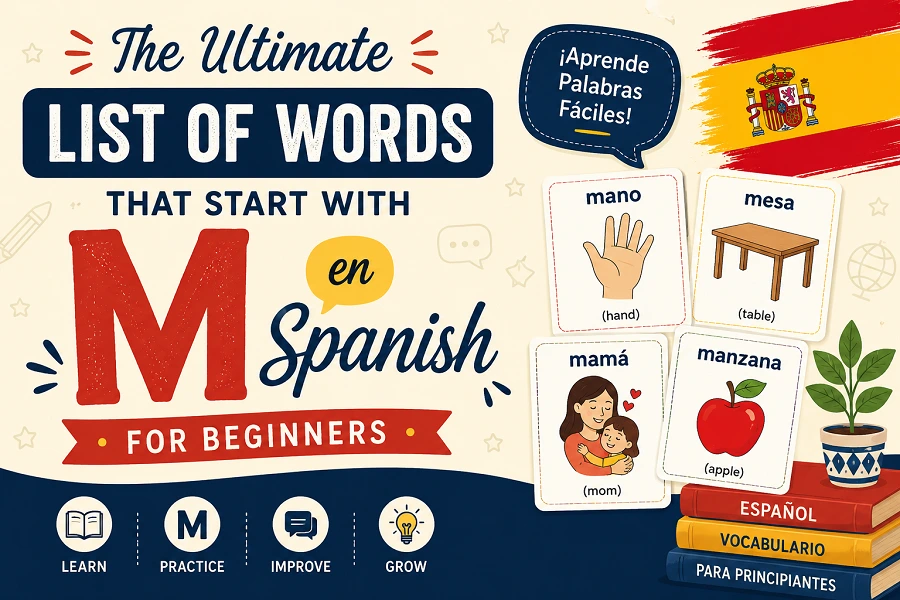
- madre (mother)
- mañana (morning / tomorrow — context decides which)
- mesa (table)
- mundo (world)
- mano (hand)
- mucho (a lot)
- mejor (better)
- mismo (same)
- muy (very)
- más (more)
Notice something? Mañana can mean two completely different things depending on the sentence. “Hasta mañana” means “see you tomorrow,” but “por la mañana” means “in the morning.” I got confused by this for weeks when I started — I once told a coworker I’d send an email “en la mañana” thinking I meant “tomorrow,” and she showed up the next morning, not the day after. Small mix-up, but it taught me to always add a specific day if I mean tomorrow.
Common nouns that start with M
Nouns are where you build your base vocabulary, so here’s a solid working list.
| Spanish | English |
|---|---|
| madre | mother |
| mano | hand |
| mesa | table |
| mundo | world |
| mujer | woman |
| música | music |
| mercado | market |
| montaña | mountain |
| medicina | medicine |
| ministerio | ministry |
| mochila | backpack |
| moneda | coin/currency |
| mentira | lie |
| miedo | fear |
| minuto | minute |
A few of these deserve a second look. Mercado isn’t just “market” in the abstract — in most Spanish-speaking cities, it refers to an actual open-air or covered market, and knowing this word will genuinely save you money on produce compared to a supermarket. Mochila is one of those words that gets used constantly with kids and students, so if you’re a parent or teacher working in a bilingual setting, it’s worth learning early.
Adjectives in Spanish that start with M
This is where a lot of learners search, and honestly, it’s a fun category because M-adjectives cover both compliments and complaints.
- malo/mala — bad
- mejor — better
- mayor — older / bigger
- menor — younger / smaller
- mismo/misma — same
- maravilloso/maravillosa — wonderful
- moderno/moderna — modern
- molesto/molesta — annoying
- mojado/mojada — wet
- maduro/madura — mature / ripe
One quick grammar note that trips people up: adjectives in Spanish that start with M often change ending based on gender — bueno becomes buena, and the same logic applies here with malo/mala or mojado/mojada. If you’re describing a person, match the ending to their gender; if you’re describing an object, match it to the noun’s gender, not the object’s “logical” gender in English.
Verbs that start with M you’ll actually use
- mirar — to look/watch
- mostrar — to show
- mandar — to send/order
- matar — to kill
- mentir — to lie
- mejorar — to improve
- mover — to move
- morir — to die
- manejar — to drive/manage
- merecer — to deserve
Here’s a practical tip nobody tells beginners: mirar and ver both loosely mean “to see/watch,” but they’re not interchangeable. Ver is passive — you happen to see something. Mirar is active — you’re deliberately looking. “Veo la tele” (I see the TV, it’s on in the background) versus “Miro la tele” (I’m watching TV, paying attention). Get this wrong and you won’t be misunderstood, but native speakers will notice.
Places in Spain starting with M
If you’re planning a trip or just curious about geography, places in Spain starting with M make for a surprisingly long list, since M is common in Spanish place names.
- Madrid — the capital
- Málaga — coastal city in Andalusia, known for beaches and Picasso’s birthplace
- Murcia — southeastern region and city
- Mallorca — the largest of the Balearic Islands
- Menorca — quieter neighbor island to Mallorca
- Marbella — upscale resort town on the Costa del Sol
- Melilla — Spanish autonomous city on the North African coast
- Medina del Campo — historic town in Castile and León
Fun fact that surprises a lot of people: Melilla isn’t in mainland Spain at all — it’s a Spanish enclave bordering Morocco. If you’re studying Spanish geography for a class or a trip, don’t skip it just because it looks unfamiliar on a map.
Numbers, time words, and everyday phrases with M
- mil — thousand
- millón — million
- medio/media — half
- martes — Tuesday
- marzo — March
- mayo — May
- medianoche — midnight
- mediodía — noon
Two days of the week and two months of the year start with M — that’s not a coincidence you need to memorize separately if you already know martes (Tuesday) and marzo (March) sound alike; the pattern just helps them stick.
Words that look alike but mean something totally different
This is the part I wish someone had told me on day one. Spanish has a few “false friend” traps hiding in the M words:
- Molestar does NOT mean “to molest” in the serious English sense — it simply means “to bother” or “to annoy.” Saying “no me molestes” just means “don’t bother me.” Still, be careful with tone and context around English speakers who might misread it.
- Embarazada (starts with E, but often confused with M-sounding words by beginners) means “pregnant,” not “embarrassed.” Not technically an M word, but it comes up in the same breath so often that it’s worth flagging here.
- Mantel means “tablecloth,” not “mantle” or “coat” — a common guess for English speakers.
A quick memory trick that actually works
Instead of memorizing words in a flat list, try grouping them by where you’d use them in a day: mañana and medianoche for time, mesa and mano for the dinner table, mercado and moneda for shopping. When I switched from flashcards to this “scene” method, retention improved noticeably — probably because your brain likes context more than raw lists. It’s not a magic bullet, and you’ll still forget words sometimes. That’s normal. Even fluent second-language speakers blank on simple words occasionally.
Final thought
There’s no shortcut to memorizing every m spanish word in one sitting, and honestly, trying to do that usually backfires — you cram, forget half of it in three days, and feel discouraged. Pick ten words from this list, use them in real sentences this week, and add ten more next week. That slow build is what actually sticks.
FAQ
1. What are some basic Spanish words that start with M?
Madre (mother), mesa (table), mano (hand), mundo (world), and mañana (morning/tomorrow) are among the most common.
2. How many common Spanish words start with M?
There isn’t an exact number, but M is one of the more frequent starting letters in everyday Spanish vocabulary, covering nouns, verbs, adjectives, and place names.
3. Is “mañana” morning or tomorrow?
Both — it depends on context. “Por la mañana” means “in the morning,” while “hasta mañana” means “see you tomorrow.”
4. What Spanish adjectives start with M?
Common ones include malo (bad), mejor (better), mayor (older/bigger), moderno (modern), and maravilloso (wonderful).
5. What are some Spanish verbs that start with M?
Mirar (to look), mostrar (to show), mandar (to send), mejorar (to improve), and morir (to die) are frequently used ones.
6. What places in Spain start with M?
Madrid, Málaga, Murcia, Mallorca, Menorca, Marbella, and Melilla are all well-known Spanish locations starting with M.
7. Does “molestar” mean the same as the English word “molest”?
No. In Spanish, “molestar” simply means “to bother” or “to annoy” and doesn’t carry the serious connotation the English word does.
8. What is “mochila” in English?
It means “backpack.”
9. Are Spanish adjectives starting with M gender-specific?
Many are. Words like “mojado/mojada” or “maduro/madura” change endings depending on whether they describe a masculine or feminine noun.
10. What does “mercado” mean, and is it different from a supermarket?
“Mercado” means “market,” typically referring to an open-air or traditional market, as opposed to “supermercado” (supermarket).
11. What’s the difference between “mirar” and “ver”?
“Ver” means to see passively, while “mirar” means to actively look or watch something with attention.
12. What Spanish months start with M?
Marzo (March) and mayo (May).
13. What Spanish days of the week start with M?
Martes (Tuesday) is the only one.
14. Is “mantel” the same as the English word “mantle”?
No, “mantel” means “tablecloth” in Spanish, which is a common false-friend mix-up for English speakers.
15. What’s a good way to memorize Spanish M words as a beginner?
Group them by real-life scenes — mealtime words, shopping words, time-related words — instead of memorizing a flat alphabetical list. Context helps retention.











Leave a Reply